Government
Davidson County Commissioner Publicly Opposes Data Centers, Citing Water, Power, and Rural Character
By Staff · July 18, 2026
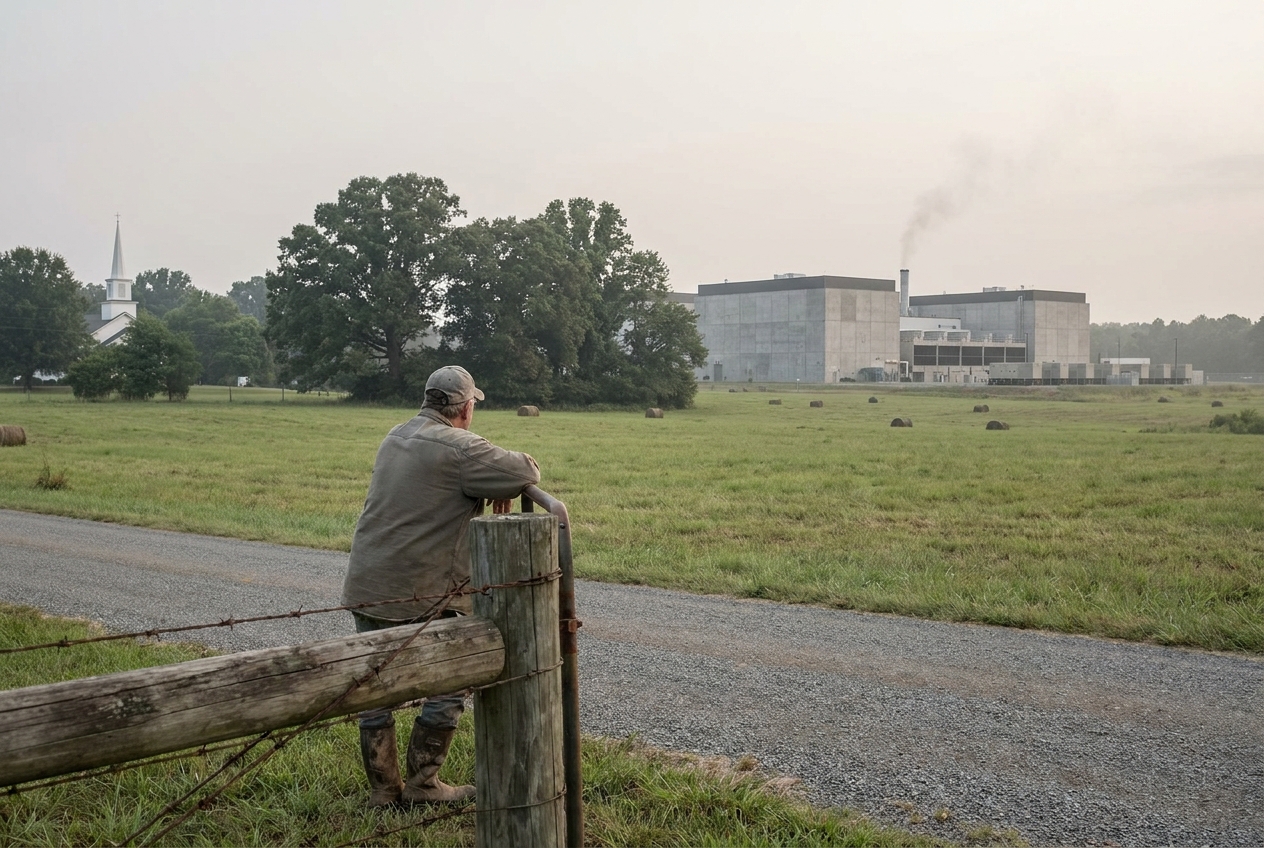
As Forsyth County weighs a proposed $3 billion data center campus in Rural Hall, Davidson County Commissioner Matt Mizell is drawing a hard line next door: the Republican commissioner says data centers do not belong in Davidson County, citing threats to water, electricity, rural character and quality of life that he believes outweigh the promised tax revenue.
His stance comes as the Davidson County Board of Commissioners voted in mid-July 2026 to direct staff to draft a six-month moratorium on new data center projects, with a public hearing scheduled for Aug. 24, 2026. Davidson County joins more than two dozen North Carolina communities that have adopted moratoriums or zoning restrictions on data centers amid concerns over infrastructure strain.
"Data centers can be described as the physical warehouse of the internet," Matt Mizell, Davidson County Commissioner, said on Facebook. "They are also massive industrial facilities with enormous demands on land, water, power, roads, and surrounding communities. For a semi-rural and suburban county like Davidson, I believe the costs and risks outweigh the benefits."
According to EPA-backed research, U.S. data centers consumed 17.4 billion gallons of water in 2023, with annual direct consumption projected to rise to between 38 and 73 billion gallons by 2028. Some data centers rely heavily on evaporative cooling, meaning much of that water is consumed and does not return to the local supply.
"Water is not some unlimited resource," Matt Mizell, Davidson County Commissioner, said. "It serves families, schools, farms, businesses, fire protection, and future residential growth. Davidson County should not place itself in a position where residents could one day be competing with massive industrial facilities for essential resources."
According to the World Resources Institute, a single modern AI data center can use as much electricity as 100,000 homes, with some larger facilities expected to use far more.
"Before any county entertains this kind of development, it should ask a simple question: who pays for the infrastructure?" Matt Mizell, Davidson County Commissioner, said. "The company? The utility? The taxpayers?"
The World Resources Institute reported that in 2024, the average data center site covered about 224 acres, roughly the size of 170 football fields, and that some hyperscale campuses exceed 1,000 acres.
"Davidson County is not a sprawling metropolis or a massive industrial hub," Matt Mizell, Davidson County Commissioner, said. "We are a county with deep rural roots, family farms, neighborhoods, churches, small businesses, and a way of life worth preserving. We can support smart growth without surrendering our identity."
"Not every dollar is worth it," Matt Mizell, Davidson County Commissioner, said. "So if the primary benefit is tax revenue, then we must ask whether that revenue is worth the pressure on water, power, land, infrastructure, county character, and quality of life. I do not believe it is."
"If data centers must be built, they should be located in places already designed for heavy industrial use: areas with abundant power capacity, immense water infrastructure, major fiber access, and the ability to absorb the impacts without reshaping rural and residential communities," Matt Mizell, Davidson County Commissioner, said.
Davidson County's move mirrors actions across the region. Neighboring Davie County unanimously approved a one-year suspension on data center proposals in July 2026. Mount Airy unanimously approved a 60-day moratorium on new data center projects the same month. Stokes County commissioners voided rezoning approval for a multi-billion-dollar Duke Energy-adjacent data center project in Walnut Cove.
That pattern of rejection may redirect development pressure toward Forsyth County, where a $3 billion hyperscale data center campus called Project Iron Spur is already pending on 129 acres in Rural Hall. Proposed by Drox Group, the project would include four buildings totaling 1.3 million square feet and a dedicated Duke Energy substation.
The Winston-Salem/Forsyth County Planning Board voted to recommend denial of Drox Group's rezoning request on June 11, 2026, and the final decision rests with the Forsyth County Board of Commissioners. The Rural Hall Town Council initially opposed the proposal but reversed its stance on June 22, 2026, voting to support the project.
At the state level, North Carolina's proposed Ratepayer Protection Act, Senate Bill 730, would require large-scale data centers to pay cost-based electric rates covering new generation, transmission and distribution infrastructure tied to their load, adopt closed-loop water or liquid cooling systems, and bar local governments from offering them tax incentives or subsidies. The North Carolina House approved the bill on second reading by a 69–44 vote on June 3, 2026.
Mizell, who won the 2026 Republican primary for Davidson County Commissioner and appears on the Nov. 3, 2026, general election ballot, framed the debate as a fundamental question of whom government serves.
"I was not elected County Commissioner to represent special interests, speculative development, or the data center industry," Matt Mizell, Davidson County Commissioner, said. "I was elected to represent the residents of Davidson County and to serve as a temporary steward of a county that must be wisely and justly governed."
"Growth should serve the people who live here," Matt Mizell, Davidson County Commissioner, said. "It should not force the people who live here to serve the growth or big business. Data centers certainly belong somewhere. But they do not belong in Davidson County."
As Davidson, Davie, Stokes and Mount Airy place limits on data center development, Forsyth County faces its own reckoning over whether to absorb what neighboring communities have refused — and what trade-offs county commissioners are prepared to accept.