Government
State Elections Board Votes to Make It Easier to Reject Ballots — What It Means for Forsyth County Voters
By Staff · July 18, 2026
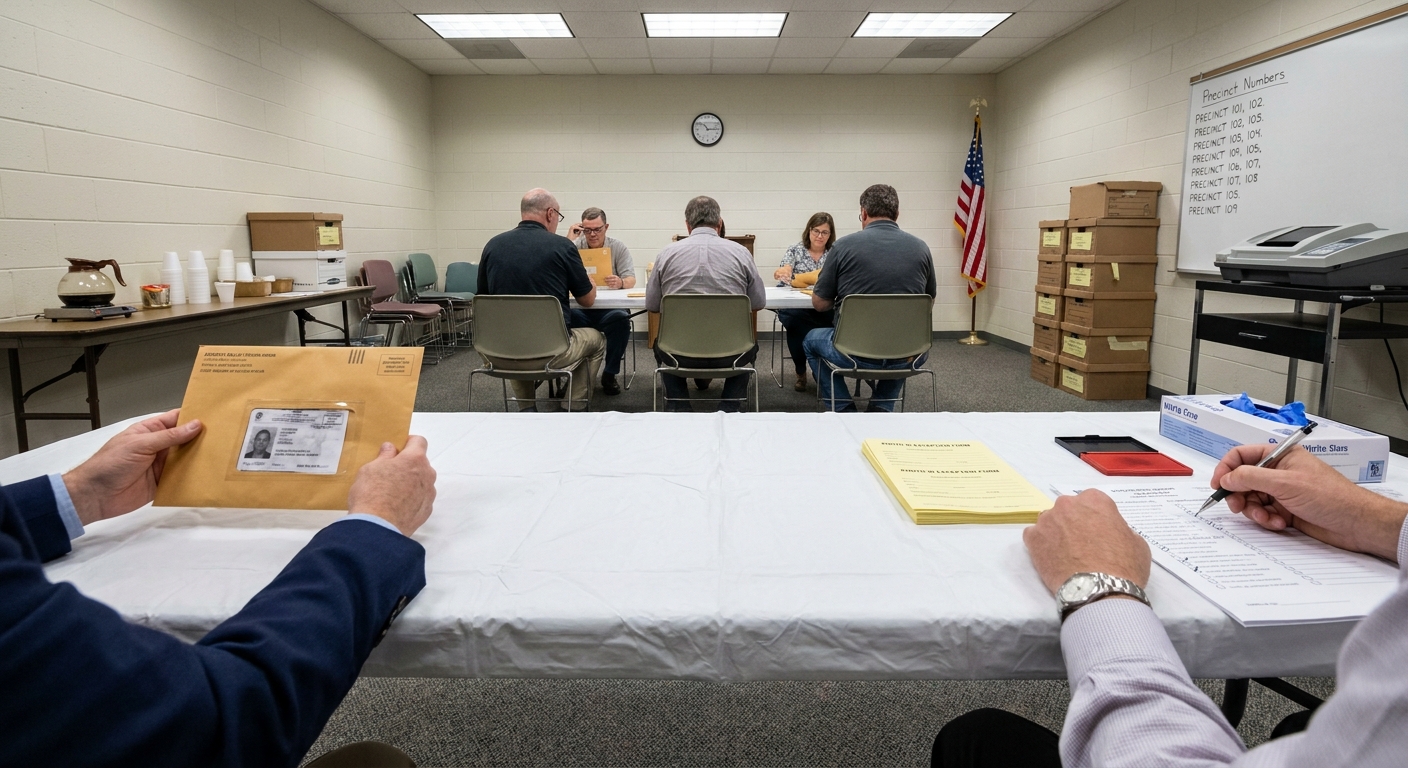
For a Forsyth County voter who cannot produce photo ID, the difference between one dissenting elections-board member and none could now determine whether a ballot counts. The Republican majority on the North Carolina State Board of Elections voted July 16-17, 2026, to replace a unanimity requirement with a simple-majority vote when deciding whether a voter's stated reason for lacking photo ID is false or illegitimate. Under the old rule, every member of a county elections board had to agree before rejecting a ballot submitted with a Photo ID Exception Form; under the new standard, a 3-2 vote is enough. The rule changes still require approval from the state Rules Review Commission before taking effect.
Forsyth County's elections board, appointed by the State Board on June 24, 2025, has three Republicans — Chad Doomy, Alfred Harvey and Adam Draper — and two Democrats — Catherine Jourdan and A.L. Collins. As of January 2026, Collins served as chairperson, Jourdan as vice chair and Doomy as secretary, according to the board's meeting minutes. That 3-2 Republican majority mirrors the state board's structure, even though as of March 2026, 34.89% of Forsyth County's registered voters were Democrats compared with 26.46% who were Republicans.
The stakes are especially clear in Winston-Salem, home to large student populations whose voting plans can be shaped by campus housing, out-of-state documents, limited transportation and unpredictable schedules. Wake Forest University enrolled 9,633 students for the 2025-26 academic year, including 5,595 undergraduates and 4,038 graduate and professional students. Winston-Salem State University reported a total enrollment of 4,972 students for Fall 2025, including 4,293 undergraduates and 679 graduate students. Together, the schools enrolled approximately 14,605 students.
The State Board approved the rules along party lines, with Democratic members opposing the changes and warning they will enable partisan boards to discard more ballots in the 2026 midterms and beyond. "It supports a lie," Jeff Carmon, Democratic Member of the North Carolina State Board of Elections, said, arguing there is no evidence of widespread voter fraud to justify stricter rules.
The board also voted on rules that could increase rejection of mail-in ballots for technical issues, new standards for campaign finance reporting and recounts, and expanded authority for voting site judges to remove individuals deemed too disruptive.
North Carolina voters with a religious objection to being photographed or a reasonable impediment preventing them from obtaining a photo ID may vote a provisional ballot by signing an affidavit called a Photo ID Exception Form. Accepted reasonable impediment reasons include lack of transportation, disability or illness, lack of a birth certificate or other documents needed to obtain an ID, work schedule, family responsibilities, lost, stolen or misplaced photo ID, having applied for a photo ID but not yet receiving it, or other voter-written reasons.
A Wake Forest student whose driver's license lists a home address in another state but who votes using a campus residence could face scrutiny if the Forsyth County board's Republican majority questions whether a stated impediment — such as lost ID or lack of transportation to the DMV — is legitimate, without needing Democratic members' agreement. An elderly voter who cites a religious objection to being photographed could have that ballot rejected by a 3-2 vote if the majority determines the objection is not sincere, where previously all five members would have had to agree.
North Carolina absentee ballots must be witnessed by two people aged 18 or older, or by one notary public, and the witnesses must sign, print their names and provide their full addresses on the ballot return envelope. North Carolina is one of only three states requiring two witness signatures on mail-in ballots unless a notary is used. Mail-in ballots also require voters to place a photocopy of an acceptable photo ID in the clear sleeve on the back of the return envelope, or if they lack an ID, complete the Photo ID Exception Form and place it in the same sleeve. A WSSU student or shift worker who mails a ballot with an ID Exception Form citing work schedule as the impediment, but whose witness left off part of their address on the envelope, could now see that ballot rejected by simple majority vote, particularly under the newly approved rules on mail-in ballot technical issues.
Forsyth County voters should verify that they have an acceptable form of photo ID; the address on the ID does not need to match their voter registration address. Voters who plan to use an ID Exception Form should understand which reasonable impediment reasons are accepted and be prepared for the possibility that the board's Republican majority may question their stated reason. Mail-in voters must ensure that two witnesses or one notary sign, print their names and provide full addresses on the return envelope, and that a photocopy of an acceptable photo ID or a completed ID Exception Form is placed in the clear sleeve.
Voters with questions about ID requirements, exemption criteria and mail-in ballot procedures can contact the Forsyth County Board of Elections, led by Chair A.L. Collins, ahead of the next election cycle.