Local News
New Federal Housing Law Could Reshape Winston-Salem Development: Wake Forest Highlights 21st Century ROAD to Housing Act
By Staff · July 18, 2026
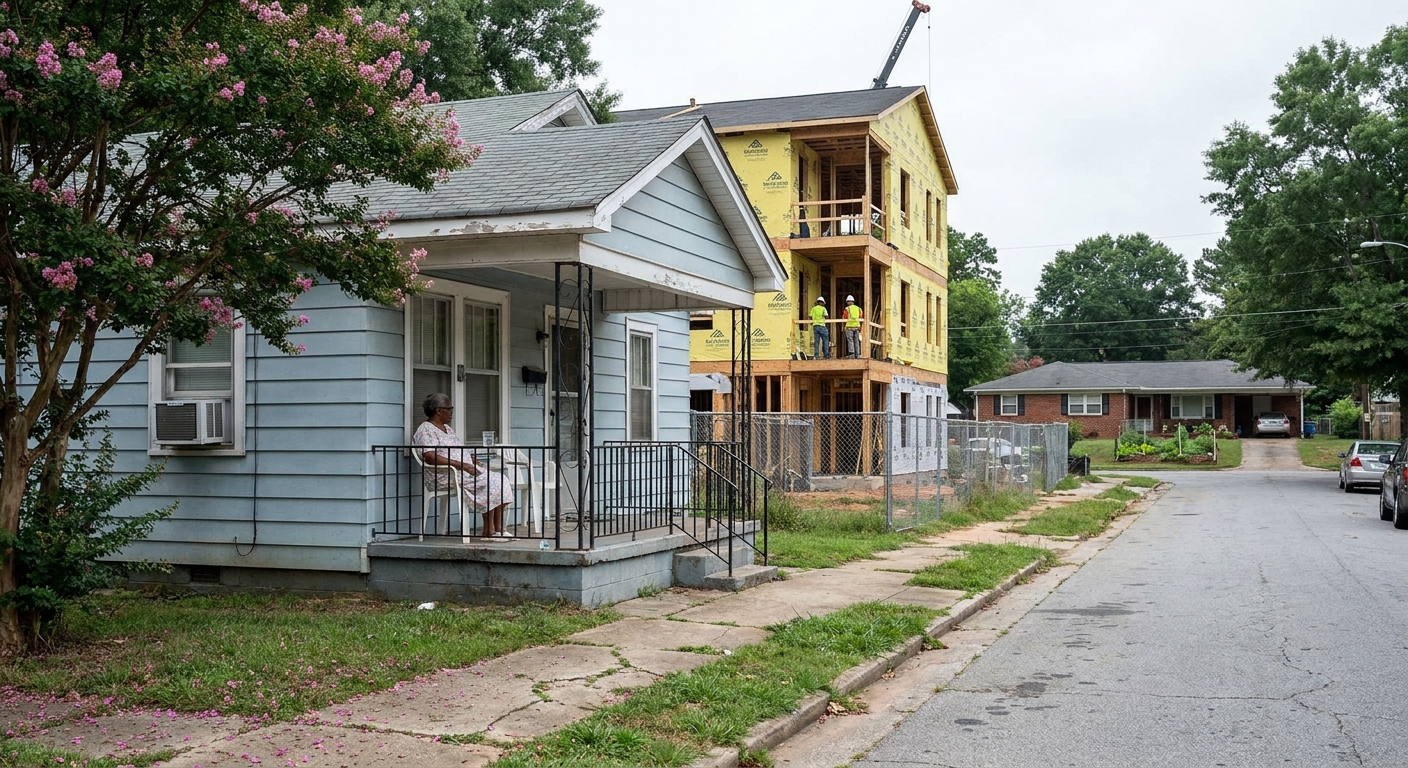
For East Winston and downtown residents watching investment reshape their neighborhoods, the 21st Century ROAD to Housing Act became law July 11 with new federal tools that could help Winston-Salem build and preserve affordable homes—or intensify the pressure that already puts longtime residents at risk of being priced out.
For the first time in federal housing policy, cities can use up to 20% of their Community Development Block Grant money to build new affordable housing, rather than limiting those dollars to repairs and rehabilitation. Winston-Salem's proposed fiscal year 2026 CDBG allocation is $2,026,576, meaning the city could direct up to about $405,315 to new affordable-housing construction.
That is not enough money to solve the city's housing crisis. It is enough to make the city's choices matter.
City Council, planners, housing authorities and developers will decide where that money goes, who builds with it and what affordability rules come with it. The question for residents is straightforward: Will federal money help working families stay in their neighborhoods, or help finance projects whose rising costs push them out?
The law does not take zoning or land-use authority away from local government. Instead, it uses federal incentives to encourage communities to build more housing. Over the next year, Winston-Salem's decisions on zoning, public spending and development requirements will determine whether those incentives support neighborhood stability or become another engine of gentrification.
Congress approved the bill 358-32 in the House and 85-5 in the Senate. It became law without President Trump's signature after he neither signed nor vetoed it within the constitutional 10-day window. French Hill led the measure in the House, while Sen. Tim Scott and Sen. Elizabeth Warren co-sponsored it in the Senate.
"Homeownership should be within reach for more Americans, and this law moves us closer to that goal," Hill, chairman of the House Financial Services Committee, said. "This bill reduces unnecessary barriers to building, strengthens community banks, and ensures families—not institutional investors—have a fair shot at buying a home."
At the heart of the act is a federal push for housing growth. It creates a $200 million-a-year Innovation Fund for fiscal years 2027 through 2031, offering grants to local governments and tribes that can show measurable gains in housing supply.
The law also links part of a community's CDBG funding to its housing-growth record. Communities that improve more than the median could receive bonus funding; those below the median would face a 10% CDBG cut beginning around 2029. For Winston-Salem, that creates pressure to put more units on the books. But residents in neighborhoods facing redevelopment pressure have a different measure of success: whether those units are affordable to lower-income households and whether current residents can stay.
HUD must issue draft zoning and land-use best-practice guidelines by July 11, 2028, with final guidelines due by July 2029. The guidance must recommend eliminating parking minimums, allowing accessory dwelling units and permitting duplexes and triplexes by right. Those changes could give builders more ways to add homes but leave local officials with critical decisions about where denser housing should go and what protections should accompany it.
The law directs the Government Accountability Office to recommend a definition of workforce housing. It defines attainable housing as housing for households earning no more than 120% of area median income, provided most units are affordable to households earning less than 60% of area median income. That standard makes room for mixed-income development but does not guarantee that a project will include enough lower-income homes to meet a neighborhood's needs. Those details will depend on local affordability set-asides attached to individual projects.
The act also bars corporate investors that own 350 or more single-family homes from buying additional single-family homes. Key provisions are scheduled to expire July 11, 2033. That gives Winston-Salem a limited window to put lasting local rules in place before the federal incentives disappear.
Housing affordability remains uneven across the city. The average rent for a one-bedroom apartment in the 27127 ZIP code is $954 a month, while East Winston remains among Winston-Salem's more affordable neighborhoods. Citywide median rent was $1,300 in July 2026, down 10.3% from a year earlier. Those citywide figures do not settle the immediate question on blocks facing new investment: Will lower-cost homes still be available where residents already live?
Sherri Lawson Clark, an associate professor of anthropology at Wake Forest University, has more than three decades of research experience in housing instability, social stratification and the relationship between housing policy, health and welfare systems. Wake Forest's analysis of the act points to structural protections intended to focus federal housing programs on direct protections for the lowest-income households, rather than broad economic measures alone.
Several provisions could reduce barriers that put low-income renters at risk. The law eliminates duplicative inspections for Section 8 apartments that have already been inspected through programs including the Low-Income Housing Tax Credit, a change intended to cut delays that can cause tenants to lose available apartments. It requires equitable distribution of Community Development Block Grant-Disaster Recovery money to help prevent displacement after disasters. And it separates federal rental assistance from maturing U.S. Department of Agriculture mortgages, a change expected to protect an estimated 400,000 low-income rural families nationwide from losing subsidies or being displaced.
Downtown redevelopment offers a clear example of what is at stake.
Brown School Lofts at Legacy Heights opened in April 2024 as the first 81-unit mixed-income phase replacing the former Cleveland Avenue Homes public housing near downtown. Fifty-one apartments were reserved for tenants earning below area median income. Legacy Heights is supported in part by a $30 million HUD Choice Neighborhoods grant. The five-phase redevelopment is planned for 406 total units, including 199 reserved for former public-housing residents, with completion targeted for 2027.
The ROAD Act raises the Rental Assistance Demonstration cap by 100,000 units, allowing housing authorities to use private financing to rehabilitate aging public-housing properties. That could give ASPIRE and other housing authorities more financing options while making resident protections and affordability commitments central to how redevelopment moves forward.
ANCHOR, a Winston-Salem nonprofit housing developer, manages more than 2,500 affordable homes for low- to moderate-income residents across North Carolina. The nonprofit has submitted an Indication of Interest to ASPIRE, formerly the Housing Authority of Winston-Salem, for rehabilitation or redevelopment of Crystal Towers, a downtown public-housing community. ANCHOR presented its vision to ASPIRE officials and resident representatives on June 11, 2026, then opened a downtown office at 635 W. Fourth St., marked by a June 17, 2026, ribbon-cutting ceremony.
Ted Ortiviz has been ASPIRE's CEO and executive director since July 8, 2025.
"I'm honored to lead ASPIRE at such a pivotal moment—not just with a new name and headquarters, but with a renewed commitment to empowering residents and reimagining how ASPIRE serves the Winston-Salem community," Ortiviz said. "My priority is and will always be the people we serve."
The law also updates maximum FHA multifamily mortgage amounts and changes the formula so they reflect market costs, which could improve financing prospects for mixed-income projects downtown and make financing more accessible to smaller developers competing with larger national firms.
The restriction on large corporate investors could leave more single-family homes available to individual buyers and smaller local builders. Those provisions give local builders and nonprofit developers a stronger opening. They do not decide whether the homes that result will remain affordable to residents being priced out of fast-changing areas.
Winston-Salem's eight-member City Council holds authority over budget and policy decisions involving zoning, affordable housing and community safety. Mayor Allen Joines is serving his seventh term after running unopposed in the 2024 general election. The council has identified affordable housing as a priority, with a goal of adding thousands of units over the next eight years. The city added 500 units in 2022 and funded 750 more for 2023.
Joines and the council adopted a $700.9 million budget for fiscal year 2026-27, including $104.8 million for capital improvements. The city now must decide how its zoning policy responds to forthcoming HUD guidance, whether to concentrate new CDBG construction dollars in East Winston or spread them across several projects, and whether to pursue Innovation Fund grants that could bring in federal money beyond the annual CDBG allocation.
The law also requires CDBG-receiving cities and urban counties to keep a publicly accessible, searchable online database of undeveloped parcels they own. Local affordability set-asides and community-benefit agreements will determine how many homes in federally supported projects serve households below 60% of area median income and how many go to higher-income bands permitted under the attainable-housing definition.
For East Winston and downtown residents, those are not technical details. They will shape whether federally backed development creates homes for current working families—or homes that become available only after those families have been pushed elsewhere.
Residents can track those choices through the required land database and the city's annual Consolidated Plan, which reports CDBG allocations and proposed uses and includes public review and comment periods. Beginning around 2029, HUD's comparison of Winston-Salem's housing-growth record with other communities will show whether the city is headed toward bonus funding or a CDBG cut. Council meetings on zoning reforms, CDBG allocations and affordability requirements offer residents a place to press for neighborhood protections. HUD's draft guidance in 2028 and final guidance in 2029 will provide another benchmark for judging the city's zoning decisions.
Before the law's key provisions expire July 11, 2033, Winston-Salem will have to turn federal incentives into local commitments—or leave East Winston and downtown with more development, but fewer options for the working families who call those neighborhoods home.