Public Safety & Courts
Davidson County Murder Indictment Served Inside Jail, Not at Checkpoint as Initially Reported
By Staff · July 18, 2026
Maleigha Loale Allen was already behind bars at the Davidson County Jail when she was arrested July 7 on a first-degree murder indictment. The 20-year-old Lexington woman had been held without bond since April 21, following her initial arrest in the stabbing death of her father, 44-year-old Michael Steven Allen. Her July 7 murder arrest was unrelated to any checkpoint operation; she had been continuously incarcerated since April.
The Davidson County grand jury returned a true bill of indictment on July 6, 2026, charging Allen with first-degree murder and stating the killing was premeditated. A grand jury had initially declined to indict Allen in May 2026, finding insufficient probable cause, but prosecutors returned to a new panel with additional evidence.
Allen was originally taken into custody on April 21, 2026, after being released from the hospital where she was treated for non-life-threatening injuries. She remained in the Davidson County Detention Center without bond even after the first grand jury declined to indict; available public records do not explain the legal basis for her continued detention during that period. Allen was scheduled to appear in Davidson County Superior Court on July 8, 2026.
The Davidson County Sheriff's Office T.R.A.C.E. Team—Traffic and Criminal Enforcement—consists of six uniformed investigators responsible for traffic enforcement and assisting the investigative division with criminal and drug cases.
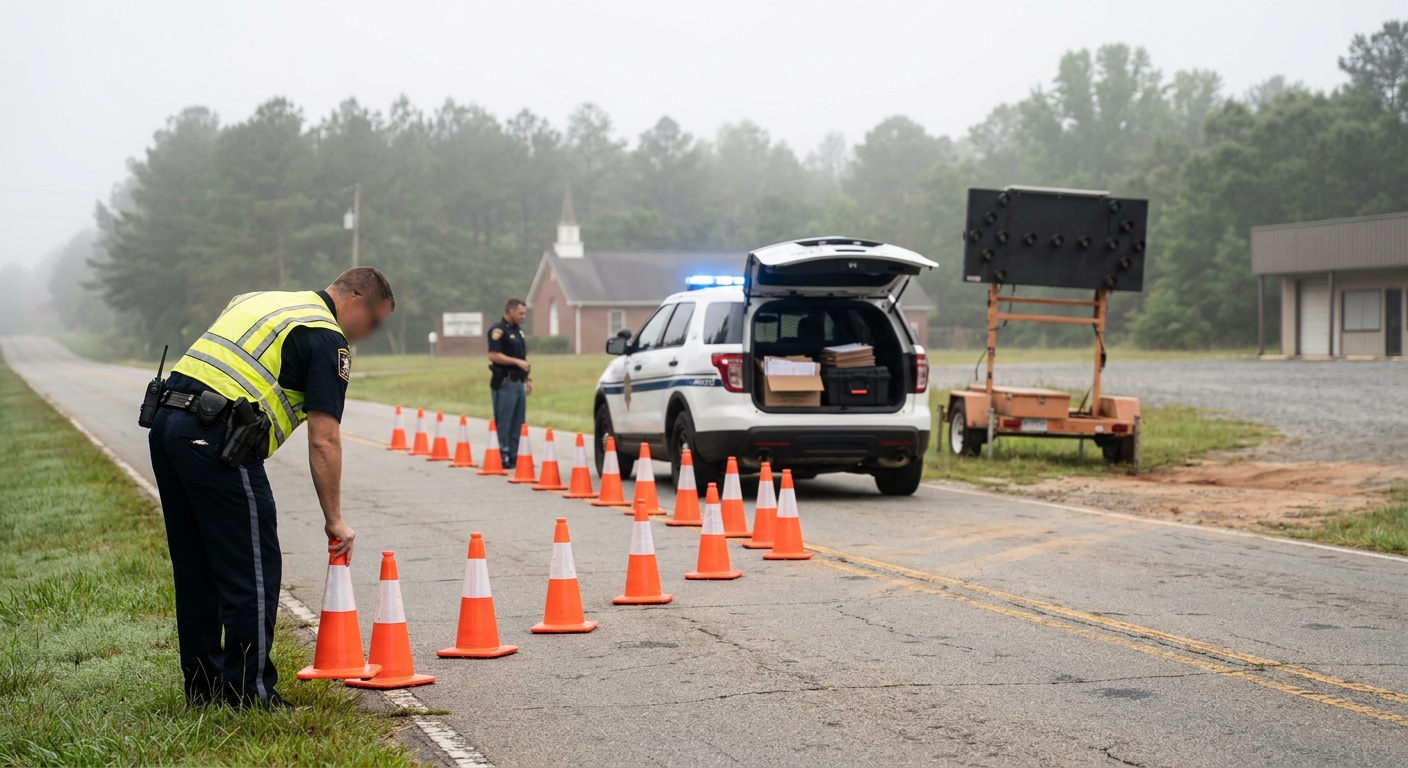
On July 3, 2026, the T.R.A.C.E. Team partnered with Thomasville and Lexington police, the North Carolina State Highway Patrol, MADD, and the Forensic Tests for Alcohol Branch to run a multi-agency checking station at US 29-70 and Hasty School Road in Thomasville. The operation produced 135 charges and 3 DWI arrests—a ratio of 45 charges for every impaired-driving arrest. Law enforcement also seized marijuana, cocaine, and fentanyl. The Sheriff's Office has not disclosed how many of those 135 charges were for license, registration, or equipment violations versus drugs, weapons, or outstanding warrants.
On July 2, 2026, the T.R.A.C.E. Team and Thomasville Police Department's DWI Task Force conducted a driver's license checkpoint on Highway 109 South at Commercial Park Drive in Thomasville. The team also ran checkpoints on May 8 at Whitehart School Road and Ball Road, resulting in a methamphetamine arrest, and on June 1 at Lacy Hepler Road and Mt. Zion Church Road, resulting in an arrest for concealed firearm by a convicted felon—at least four checkpoints in a three-month span, all in the Thomasville area. The Davidson County Sheriff's Office stated that collaborative checkpoint enforcement efforts are intended to reduce impaired driving, remove illegal drugs from communities, apprehend wanted offenders, and improve roadway safety throughout Davidson County.
In North Carolina, driver's license checkpoints are authorized under N.C.G.S. § 20-16.3A, which requires law enforcement to operate under a written policy designating in advance a predetermined, neutral pattern for stopping vehicles, with no individual officer discretion in selecting which drivers to stop. All checkpoints must be approved by a district supervisor or higher authority, and at least one law enforcement vehicle must have its blue light activated to advise the public.
Every driver passing through these checkpoints was subject to a stop under the neutral-pattern rule—no individual suspicion required. The Sheriff's Office has not published data showing whether checkpoint locations and timing affect which neighborhoods and economic groups bear the highest burden of stops and citations.
For each driver who received one of those 135 charges on July 3, the outcome will determine whether the checkpoint is experienced as public-safety protection or as a costly entanglement with the justice system—a $200 ticket for expired registration, a court date that conflicts with work, a drug charge that triggers pretrial detention, or a DWI arrest that may have prevented a crash. The false claim that a murder suspect was caught at a checkpoint may reflect a broader public belief—encouraged by law-enforcement messaging—that checkpoints routinely apprehend serious offenders, even though the documented 2026 outcomes show drug and weapons arrests alongside high volumes of charges whose severity and ultimate disposition remain undisclosed.